Sandustry Materials Guide
Sand, water, gold, slag, redsand, fluxite, and copper—how each pixel behaves and where it fits your factory loop.
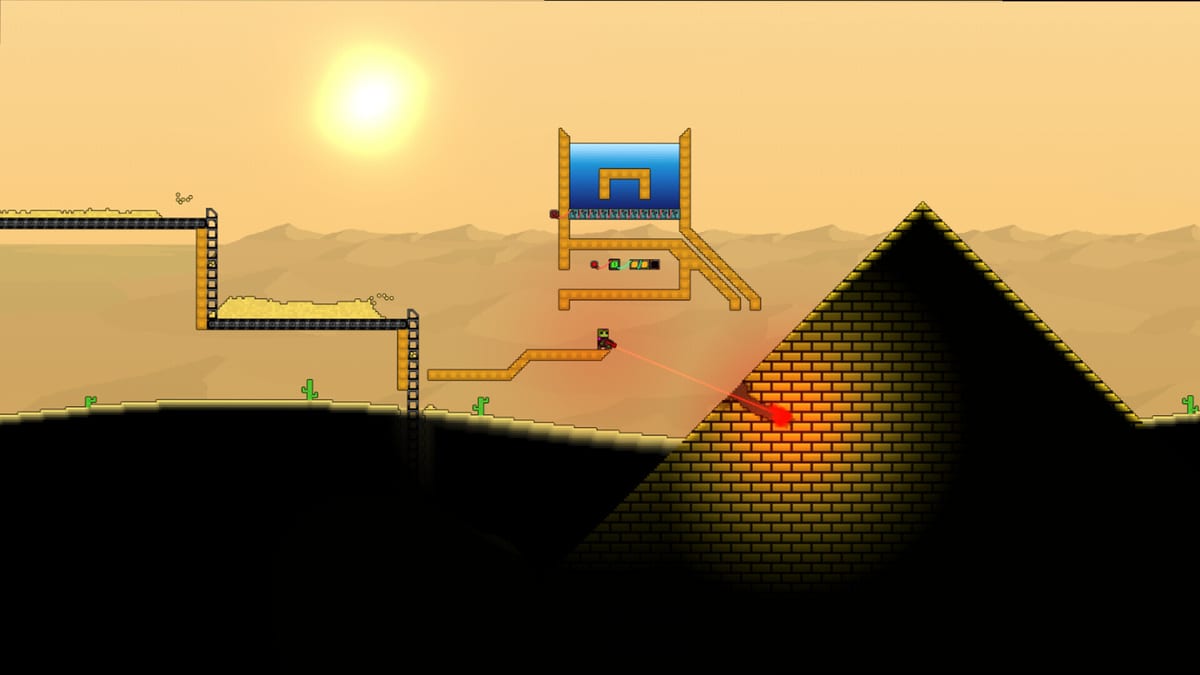
Sandustry treats every dug pixel as a physical material with density, temperature, and interaction rules. Whether you are running the Early Access build or the free demo, understanding those materials is what separates a tidy gold line from a clogged pit of slag and steam. This hub collects the core resources you will touch in the first hours and the advanced ones that appear once you push deeper into the world.
The core refining loop
The backbone of Sandustry progression is a simple chain with messy physics attached. You mine Sand, combine it with Water to create Wet Sand, feed Wet Sand through a Shaker to extract Gold and Slag, then burn Slag into Burnt Slag for further processing on a Kinetic Slag Press. Community testing puts shaker gold yield around twenty to twenty-five percent per Wet Sand input, but your exact numbers depend on belt timing, pile depth, and how cleanly you separate outputs.
That loop sounds linear, yet sand physics makes it anything but. Wet Sand behaves differently from dry Sand when it lands on a diagonal shaker screen. Slag is heavier and tends to sink unless you route it deliberately. Gold is precious enough that even small losses to misaligned conveyors hurt your research budget. Read the dedicated Sand and Wet Sand and Gold and Slag pages before you scale automation.
Water, ice, and steam
Water is not just a crafting ingredient—it is a fluid that can flood tunnels, freeze into Ice, and boil into Steam when heated. Sand absorbs a limited amount of water before becoming Wet Sand, and the one-plus-one rule (one Sand plus one Water yields two Wet Sand) is one of the first ratios players memorize. Managing that conversion without drowning your dig site is a skill on its own.
Steam and ice show up once you bring heat and cold tools into the mix. The Water, Ice, and Steam guide covers capture strategies, pipe routing, and why steam pockets can stall a wet-sand line if you ignore them. Pair it with the Pipes and Pumps building guide when you are ready to move liquids at scale.
Snow, Firn, and Frostbed are the other water story. Burn snow for Water — the only renewable water path besides duplication tricks. Firn must be dug before it burns. Snow plus water makes Ice; snow plus lava makes Scoria and eats the snow. Full rules: Snow, Firn, and Frostbed.
Redsand, fluxite, and deeper resources
Past the starter biome you will encounter RedSand, a denser sand variant tied to Fluxite production through Amethelis and Voidbloom. Flowers drop Amethelis petals; mixing petals with RedSand creates Voidbloom for the sole Flux Emanator, which grows Fluxite below its tile. Community spreadsheets often cite a rough ratio of two Sand to three Water to four RedSand producing about three Gold to eight Fluxite, though slag burning efficiency shifts those numbers. Lava sits between RedSand and Gold on density charts players share online, which matters when you filter mixed piles. Relocate heat with the Scoria → Cinder → remelt chain (Lava, Scoria, and Cinder). Spores from the Kinetic Slag Press feed planters (Spores and Seeds).
Soil and Fire appear in farming and hazard contexts—planter boxes need soil, while fire can spread through organic tiles if you are careless with a flamethrower. Read RedSand and Fluxite for mining priorities, Voidbloom and Amethelis for botanical density and mixing, and Material Ratios for community benchmarks.
Copper and power systems
Copper appears in mid-to-late game as a resource extracted with a drill from stone caverns. Smelt Copper Ore in a Smelter to produce Liquid Copper, which flows through pipes to casting molds. The primary use of Liquid Copper is crafting Power Bricks — rechargeable battery molds that store Florinol energy for portable power. See Copper and Power and the Smelter building for the complete copper power chain.
How materials connect to buildings
Materials do not refine themselves. Shakers need a steady Wet Sand feed; Conveyors and Launchers keep piles moving; Filters split densities when manual sorting fails; Drones haul bulk when belts cannot reach. The Flux Emanator consumes Voidbloom and grows Fluxite below its footprint — only one per factory. The Buildings Hub maps each machine to the materials it handles best.
For step-by-step factory planning, cross-read the How to Get Gold guide and the Research Priority Tier List. Tool choices—flamethrower for slag, vacuum for relocation—are ranked on Tools and Weapons Priority.
Pick your next read
New players should start with Sand and Wet Sand, then Gold and Slag. If water is backing up, jump to Water, Ice, and Steam or Snow, Firn, and Frostbed. Mid-game diggers should open RedSand and Fluxite, Voidbloom and Amethelis, Florin and Florinol for the Energy fork, Lava, Scoria, and Cinder, and Spores and Seeds. For late-game power systems, read Copper and Power to learn about smelting copper ore and crafting Power Bricks. Keep Material Ratios bookmarked when tuning throughput.
Frequently Asked Questions
Quick answers to the most common Sandustry questions.
What is the first material loop in Sandustry?
Mine Sand, add Water to make Wet Sand, run Wet Sand through a Shaker for Gold and Slag, then burn Slag into Burnt Slag for press processing. See Sand and Wet Sand for the wetting rule.
How much gold does a Shaker produce?
Community tests report roughly twenty to twenty-five percent gold from Wet Sand inputs, but pile depth and belt timing change results. Compare notes on Material Ratios.
Where does Fluxite come from?
**Flowers** drop **Amethelis**; mix with **RedSand** → **Voidbloom** → feed the **Flux Emanator** → harvest **Fluxite** below. Read How to Get Fluxite and Voidbloom and Amethelis.
Why do density charts matter?
Sand, Wet Sand, Slag, RedSand, Lava, and Gold stack and separate by density. Filters and launchers exploit those gaps—see Filters and Material Ratios.
Which material page should I read after gold?
If slag is piling up, read Gold and Slag and the Slag Processing guide. If water floods your mine, start with Water, Ice, and Steam.
How do I get renewable water besides lakes?
Burn **Snow** or dug **Firn**. Steam also rains back after about 30 seconds. See Snow, Firn, and Frostbed and Water, Ice, and Steam.